
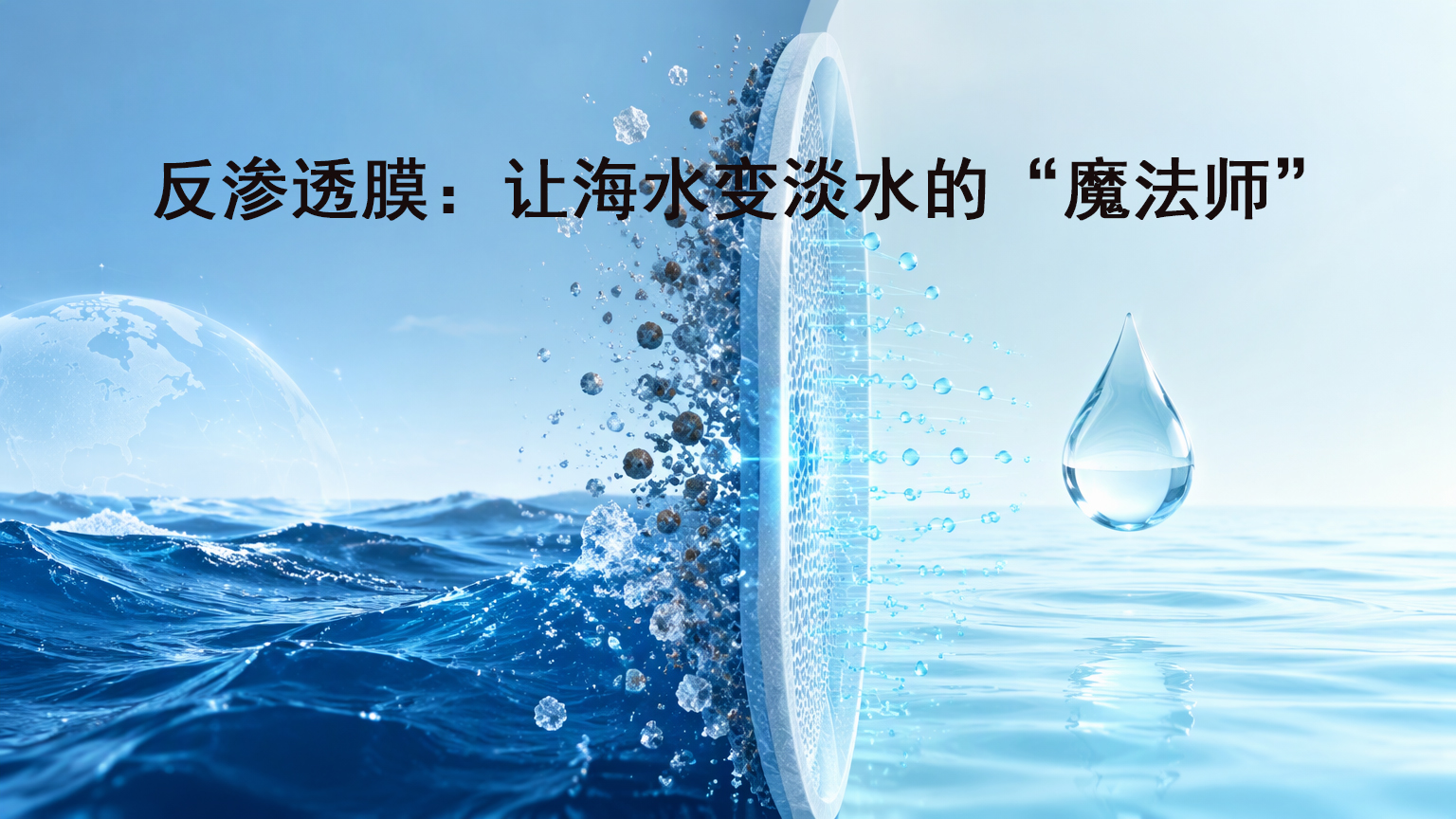
Reverse Osmosis Membranes | Turning Seawater into Fresh Water
Earth is truly a water planet. Oceans cover approximately 71%. From afar, this blue planet appears rich in water. Yet fresh water accounts for only 2.5%, most of it locked in polar ice. The fresh water directly available for human use represents less than 0.3%。
Around 2.1 billion people worldwide lack safely managed drinking water, while around 3.6 billion people face seasonal water shortages, and the number continues to rise.
Abundant seawater, but scarce fresh water: what can we do?
Part of the answer lies in reverse osmosis: an exceptionally thin membrane that helps turn seawater into fresh water.
1. Reverse osmosis: from inspiration to six decades of development
The article traces this inspiration to seabirds.
In the 1950s, scientists observed how seabirds could cope with seawater despite its high salinity. This account describes a biological separation mechanism as an inspiration for pressure-driven desalination: water passes through a selective barrier while concentrated salts are removed.
The article dates early desalination work at the University of Florida to 1953 and practical U.S. government applications to 1960. By 2025, reverse osmosis accounted for 70.54% of China's desalination capacity, making it the mainstream process. The article reports 2025 national capacity of 3.077 million tonnes/day, an increase over 2020 of 86.4%。
The cited figures put China's daily desalination capacity above 3 million tonnes, equivalent to the daily domestic water use of 15 million people.
2. How the separation works
The article describes the membrane's separation scale as 0.0001 micrometres (0.1 nanometres), using this comparison to illustrate the extremely fine selectivity of the membrane relative to microorganisms.
The basic process is straightforward:
- A high-pressure pump drives seawater towards a semipermeable membrane.
- Applied pressure drives water through the membrane to the permeate side.
- The membrane retains salts and other contaminants, which leave in the concentrate stream.
By separating water from dissolved salts, membranes make seawater desalination a practical source of fresh water.
3. Desalination and the people it serves
Seawater desalination continues to expand. The article cites an estimated global capacity in 2025 of 68.31 million tonnes/day. In the Middle East and many island regions, desalinated water is a major drinking-water source.
4. China's growing role in desalination technology
China's desalination sector is moving beyond domestic supply towards exports of technology and equipment.
The article cites the Tianjin Institute of Seawater Desalination and Multipurpose Utilization on the sector's transition from domestic innovation to international development. Chinese RO membranes are used in large desalination projects in Tianjin, Shandong and elsewhere, with applications expanding overseas.
From imported technology to domestic development and exports, China's membrane industry is reaching international markets.
Closing thoughts
The ocean is also an opportunity to address fresh-water scarcity. Reverse osmosis is not magic: it is engineered separation technology that turns seawater into a usable water resource for communities and industry.
DALTONEN — supporting lasting environmental progress