Nanofiltration in Zero Liquid Discharge
A Key Link in Selective Salt Recovery
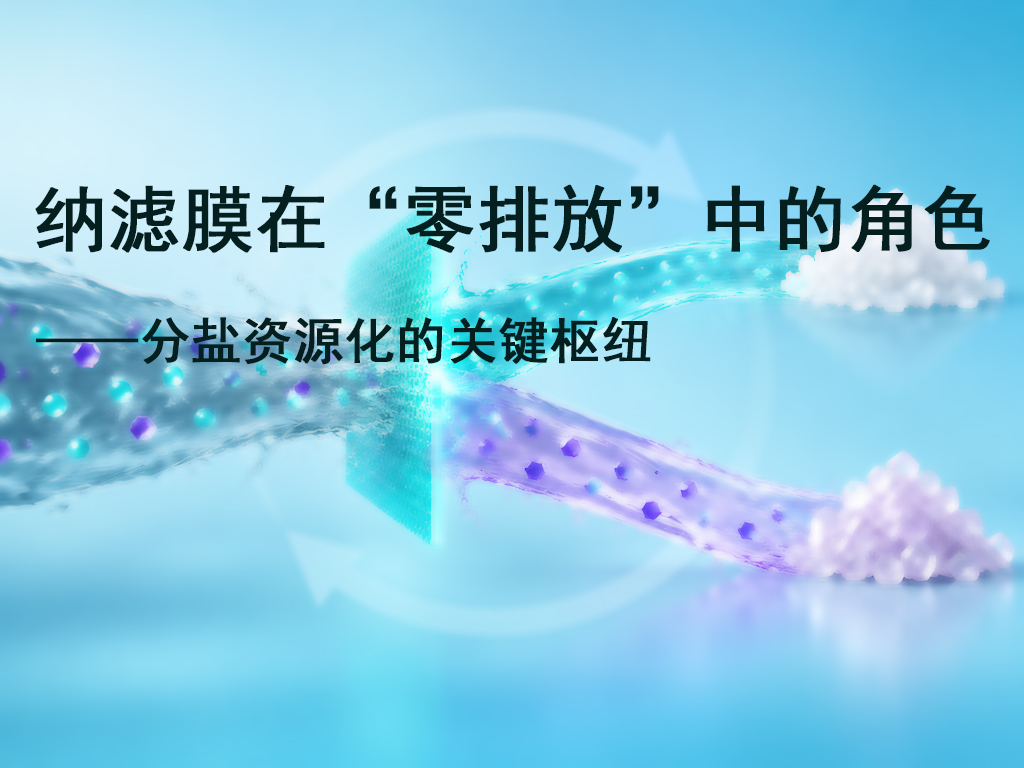
As industrial wastewater treatment advances toward zero liquid discharge, nanofiltration (NF) plays a connecting role. Unlike RO, which generally rejects a broad range of ions, or UF, which mainly screens particles, NF offers selective ion separation. It bridges RO and evaporation/crystallization, allowing ZLD to move beyond pollutant reduction toward a process that can recover salts.
Why Separate Salts? The Challenge of Mixed Residues
To understand NF's value, consider a common limitation of conventional ZLD. Many industrial wastewaters, including coal-chemical, desulfurization and textile effluents, contain substantial sodium chloride and sodium sulfate. Concentrating them directly by RO and then crystallizing them together produces a mixed-salt residue.
Such residues have complex compositions and low purity. The source article describes cases where they are classified as hazardous waste and require costly disposal, sometimes several thousand yuan per tonne, adding landfill pressure with little recovered value. Modern salt-recovery ZLD instead seeks separate recovery: anhydrous sodium sulfate and industrial sodium chloride. NF's selective separation helps make this possible.
Nanofiltration: Selective Access for Ions
NF has an effective pore scale between UF and RO, often described as around 1 nm, but its important distinction is charge-based separation, including the Donnan effect. Membrane surfaces are commonly negatively charged, producing different rejection behavior:
- Divalent and higher-valence ions, such as sulfate SO42-, calcium Ca2+and magnesium Mg2+, are strongly rejected; rejection may exceed98%;
- Monovalent ions, such as chloride Cl-and sodium Na+, pass more readily; typical rejection is between20%—60%, depending on the membrane and conditions. Pressure and membrane chemistry can sometimes produce apparent negative rejection, favoring passage.
Think of selective access through a channel: divalent sulfate is largely held back while monovalent chloride passes more readily. This selective permeability supports separation of mixed monovalent and divalent salts.
NF as the Connecting Stage: Integrating RO and Crystallization
In a typical ZLD salt-separation process, NF connects upstream RO with downstream evaporation and crystallization. The sequence is as follows:
-
Stage One: RO Preconcentration
Following softening, UF and other pretreatment, conventional RO or SWRO substantially concentrates the wastewater. RO permeate is reused, while concentrate TDS typically reaches approximately3%—5%. Monovalent and divalent salts remain mixed at this point. Direct evaporation would require substantial energy and tend to produce mixed salts.
-
Stage Two: Selective NF Salt Separation
The RO concentrate enters NF, where salts are redistributed:
- NF Permeate:Most sodium chloride (NaCl) passes through with some residual sulfate, forming a relatively clean, sodium-chloride-rich saline stream.
- NF Concentrate:Most sodium sulfate (Na2SO4) is retained and separated from the chloride-rich stream. Divalent salts, organics and hardness ions accumulate in this concentrate.
NF divides one complex saline wastewater into two compositionally different streams, preparing each for a separate recovery route.
-
Stage Three: Separate Concentration and Crystallization
After separation, both streams usually require further concentration before crystallization is economical, often to TDS levels above one hundred thousand mg/L. Further targeted concentration is therefore needed:
- Sodium Chloride Line:NF permeate enters high-pressure RO, such as DTRO or HPRO, or electrodialysis (ED), concentrating the solution toward saturation, for example to a TDS of8%—12%, before evaporation/crystallization, potentially using MVR, produces sodium chloride crystals with a reported purity above99%, subject to meeting the applicable industrial-salt requirements.
- Sodium Sulfate Line:NF concentrate is softened to reduce scaling risk, then further dewatered by NF or high-pressure RO. Near-saturated sodium sulfate enters cooling crystallization, exploiting its temperature-dependent solubility to form the decahydrate, or evaporation/crystallization to recover anhydrous sodium sulfate, with a reported purity above98%)。
Without upstream separation of sulfate and chloride, RO and crystallization must handle a complex mixed-salt system that is susceptible to scaling and makes single-salt recovery difficult. NF decouples this system into two recovery lines.
Benefits and Practical Challenges
NF salt separation can materially change the process. The source article describes scenarios in which the share of mixed hazardous salt residue falls from100%tobelow 10%, while recovered industrial salts offset part of treatment costs and support near-zero or zero liquid discharge. Targeted separation and concentration can also reduce crystallizer duty and energy demand.
The challenges remain significant. NF needs appropriate feedwater pretreatment to control calcium, magnesium, silica and strong oxidants. Calcium sulfate or barium sulfate scaling can rapidly reduce performance. Organic fouling also requires attention; advanced oxidation or activated-carbon treatment may be considered according to the water chemistry.
Conclusion
In ZLD, NF is more than an additional filtration material. Selective ion separation connects RO's concentration capability with downstream crystallization and salt recovery.
By directing sodium chloride and sodium sulfate into separate streams, NF can turn waste salts into useful resources. An effective, stable NF salt-separation stage is an important distinction between conventional mixed-salt ZLD and modern selective salt-recovery ZLD.
This article is a general technical introduction, not a set of project-specific design parameters.DALTONEN MembranesNF membrane supply and ZLD process-design services.